Tuesday, September 30, 2008

National Day


It's National Day again with plenty of flags everywhere as per usual - on my street the local neighbourhood committee of bothersome old ladies have been around instructing each building to make sure their flag is displayed. Of course this year there's a lot of Olympics and space walk stuff around too and you don't see many pictures of old Uncle Joe anymore but of course you would have in 1951 when pictures like these were passed out by a previous generation of neighbourhood committees.

Monday, September 29, 2008

London Junk


I'd long heard about the 1848 visit of a genuine Chinese junk to London. not sure when exactly, probably school and then various books. The junk had actually been sailed from Hong Kong by a largely Chinese crew which was presumably no mean feat. It was moored at Blackfriars Bridge from 1848 attracting crowds of curious visitors including Charles Dickens. Commercially it was apparently a success and made the backers some money with many people repeat visiting. Not sure whatever happened to the junk - presumably it was eventually broken up in London rather than sailed back to China again. Anyway, came across a sketch of it the other day which made me think of it again and Dickens wandering around the junk probably comparing it to the horrendous prison hulks moored a bit further down the Thames.


BTW: if you're in Sydney there's a great little exhibition about the English prison hulks in the UK, West Indies and in Australia which is well worth a visit.

Sunday, September 28, 2008

Harrison Forman Making Newsreels in Shanghai


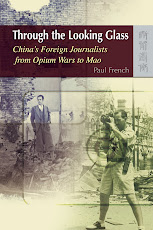
My next book is now finished (over to the editor to sort out my appalling grammar) bar sourcing some pictures. It’s a history of the foreign press corps in China from the Opium Wars to the 1949 Revolution called Through the Looking Glass and should be out next March from Hong Kong University Press. Pretty pleased with it – it’s hopefully somewhat of a romp through about 150 years of the foreign press in China from the first English language newspapers in the Canton Factories to after the War. Hopefully it’s not all that heavy either – I’ve focussed on the characters rather than writing a Phd so it should be fun – plenty of drunks, philanderers, spies, fascists, communists and general nerdowells as you’d expect when writing about the press.

Came across this picture of the great Harrison Forman shooting a newsreel in Shanghai in 1937 just after the Japanese attack – he’s on Range Road somewhere.


Forman was an interesting character, a Milwaukee native and graduate of Wisconsin University where he got a degree in Oriental Philosophy and later became known as “a modern Marco Polo” in America for exploring Tibet. He had started out in Shanghai selling planes as well as writing about the developments taking place among the country’s young engineers and industrial designers. He sold articles to trade magazines and wrote a book called So You Want to Fly? He then worked briefly for the Shanghai Times before moving on to more broad based freelance journalism for the likes of the New York Times (basing himself in Chongqing which was rather unfashionable at the time) and the Times who allowed him to travel extensively. In 1932 he organized an expedition by motor caravan to Central Asia and was the first Westerner to drive a car to the shores of Tibet’s Lake Kokonor. His Tibet travels paid of when he was hired as a consultant by the Hollywood movie director Frank Capra who was preparing to make his film version of James Hilton’s 1933 book Lost Horizon about a plane crash in Tibet and the discovery of the magical mythical land of Shanghai-La. Forman drew a salary of US$500 per week for several weeks until his contract ended; Capra never asked him one question during the whole time, so he pocketed the money and went back to his regular work.

Friday, September 26, 2008

Chocolate Shanghai


Wandering through the former French Concession these days I seem to keep bumping into chocolate shops, or Chocolatiers as the continentals would have it. The one pictured is on Fuxing Road and looks rather nice and cosy. Chocolate, the real stuff that is, has always been a bit of a mystery to many of us raised in England and addicted to the combination of vegetable fats that are passed of as chocolate. And now we have the corporatisation of chocolate in China with the opening of Hershey World in Raffle Plaza on Xizhang Road.

Still, chocolatiers, the real thing and not Hershey’s, in the French Concession is, you’ve guessed it, nothing new. Helen Foster-Snow, who’s pen name was Nym Wales and was married to Edgar ‘Red Star Over China’ Snow, was also someone who knew how to enjoy life. When the Snows lived in Shanghai she was a habitué of the famous and extremely popular Chocolate Shop on Bubbling Well Road, a home-from-home for Americans in the International Settlement, where she and Edgar would come to enjoy sandwiches, salads and ice cream. The Chocolate Shop pops up in so many memoirs of old Shanghai it must have been good. It was still around in 1945 according to the Flying Tigers Guide to Shanghai. Hopefully these new chocolate shops will last a good long while too – so much nicer than just another bloody Starbucks blanding the neighbourhood.

The Street Signs They Are A Changing


The last few days have seen some odd scenes in Shanghai's former French Concession. Tourists and locals wandering around lost and unable to find any street signs. Shanghai is currently in the midst of changing over its signage. It seems the crew tasked with removing the old signs has been round and uprooted and removed the old style road markers. However, they have not yet been followed by the crew tasked with putting in the new signs. So roads are now mysteries. Frenchtown is a rabbit warren and parts of its still extremely charming. Surprising how even people who know the area well have got lost at night recently. With the long October holiday coming it may be that the new signs don't get put up till mid-October leading to a lot more confused tourists.


As to the design of the signs themselves well take your pick - the new one is blue, the old green. The older ones seem slightly better to me for what it's worth. As to why the old ones needed replacing I have no idea but local government is local government all over the world and ours is never to reason why.

The Deflation of Exoticness Courtesy of the Ad Man


Lunched with a group of American investors and fund managers on their first trip to Shanghai this week who dropped in to ‘kick the tyres’, as they like to say. One very disappointed Connecticut analyst who’d come from Pudong Airport to the Grand Hyatt and then by mini-van to the Bund complained that all he’d seen in Shanghai so far were adverts for western brands – from Motorola to Coke and McDonalds to GE.


I consoled him with the thought that his grandfather would’ve probably experienced the same deflation of ‘exoticness’ upon arrival. The veteran inter-war New York Times China Correspondent Hallett Abend arrived in Shanghai in 1926 for the first time. As his ship sailed towards the Bund he excitedly gawped out of his porthole eager for a glimpse of the Orient and the fabled city of Shanghai. All he could see was a massive billboard for a famous brand of American chewing gum, which rather flattened his mood. He mused dejectedly that he might as well as have been sailing up the Hudson as the Huang Pu. Things got more exciting for Abend, but first glances were disappointing.


I don't know for sure but I suspect the man responsible for the ads that deflated Abend's exotic expectations was my old hero Carl Crow (providing an opportunity for a quick plug - Carl Crow, a Tough Old China Hand still available) so here's a recently unearthed picture of one of his Shanghai advertising billboards from the 1930s.

Thursday, September 25, 2008

Talking of the Yongle Emperor


Been looking at the numbers for grain stocks and inflation last few days which brings us back to the yongle Emperor again. The government’s announcement back in April that it would step in to control prices of staples to ensure supply and affordability was meant to reassure consumers. Since then, what with the French, earthquakes and Olympics nonsense dominating the news agenda, food inflation and the possibility of stricter controls slipped down the Zhongnanhai totem pole of importance. Of course when it comes to statements about price controls exciting the people we’ve been here before in 1989 when the government’s handling of price controls was certainly one of the issues that led up to the Tiananmen Square demonstrations. But puzzling the problem of subsidies can take you back further.

Back in the 1400s Beijing’s largest rice market was the Dongjiangmishi at East River Alley where the old Legation Quarter (or what’s left of it in between the usual Stalinist monstrosities and now the vandal Handle Lee’s attempts to ruin it with his bonkers ideas of restoration) is now located. The Yongle Emperor created the market and reopened the Grand Canal to supply it. The government back then hoarded rice in massive granaries in the middle of the city and then subsidised prices to keep it low. They also only parcelled it out to needy vassal states and provinces when politically expedient to do so. All of the original warehouses are gone now but subsidies and hoarding remain as does supplying vassal states as when deemed politically necessary – i.e. these days meaning grain supplies to North Korea.